Wednesday, November 18, 2009
Nathan Shedroff
Nathan Shedroff is a speaker on experience design and consultant for companies on creating strategies in establishing a better relationship with customers. In his lecture at the UCDavis Bainer hall on November 18, 2009, he touched upon many topics that was very important to the issues of today's world. Nathan Shedroff's speech on sustainable innovation is very interesting because he starts off with describing a lot of data; Cuba is the most sustainable nation, India is the country with the least consumerism, Brazil is sustainable by managing their budget very well. His knowledge for these information brings attention to his legitimacy of what he presents. He continues to discuss about sustainability, which is a rising problem in today's society. He explains that design, business, and sustainability are all interrelated with one another. The purpose of design is to market a product for business, to be successful in business, the product must be sustainable, and to be sustainable, one has to design cleverly. Sustainability is becoming an issue today as more and more resources are being depleted to catch up with the fast pace creations of design. Another interesting point is how he criticized the theories of economics and how inaccurate their measuring tools are of showing our progress in the economy. The GDP graph only considers mathematical factors and fail to consider many situational problems. To criticize a theory that has been so popularly known and used for decades is a very bold statement but his opinions are agreeable. As a designer, he uses his knowledge of experience design crossing the line into the world of economics to help improve businesses.

Objectified
The film "Objectified" by Gary Hustwit is a documentary on the importance of design that surrounds everyone in their daily lives. Many of objects that we use everyday are designed in such a way to benefit us and make our lives much more convenient. Hustwit's film not only shows the beneficial factors of design but also its rising problems because of design. Things are being produced at a rapid pace with new creations nearly every month and old products that are still capable of doing its job are being tossed for the improved versions of it. This creates a new problem that designers must now consider. Designers are now faced with a new challenge in not only improving the product itself but to also be able to improve the product in a way that makes it environmentally friendly. The easiest solution is to use every last bit of resource into making the product and using biodegradable materials. Apple is a good example of this solution. Every little piece is used into making a product and most of them are made from aluminum, which are highly recyclable.
The transitions throughout the documentary are very interesting as they are incredibly fluid and smooth from one subject to another. The usage of different languages parallels the idea that design is a universal consistency between many countries by the many people that are interviewed in the film. It also shows the different fads from different kinds of culture. This idea draws attention to the fact that design is both the global solution and problem to the society. The way the film started and ends also gives a sense of warning in how much this world has affected and changed by design. In the beginning, consumerism was emphasized (such as the showing of machines mass producing plastic chairs) but as the film continues on, it focuses more on the idea of the relationship with the object. Finally in the end of the film, a huge contrast is made in the idea of enjoying the objects that are already there instead of trying to accumulate new things. This is a message in trying to get people to be more sustainable despite the excitement of the ever changing new designs.
The transitions throughout the documentary are very interesting as they are incredibly fluid and smooth from one subject to another. The usage of different languages parallels the idea that design is a universal consistency between many countries by the many people that are interviewed in the film. It also shows the different fads from different kinds of culture. This idea draws attention to the fact that design is both the global solution and problem to the society. The way the film started and ends also gives a sense of warning in how much this world has affected and changed by design. In the beginning, consumerism was emphasized (such as the showing of machines mass producing plastic chairs) but as the film continues on, it focuses more on the idea of the relationship with the object. Finally in the end of the film, a huge contrast is made in the idea of enjoying the objects that are already there instead of trying to accumulate new things. This is a message in trying to get people to be more sustainable despite the excitement of the ever changing new designs.
Tuesday, November 17, 2009
Polaroid PoGo
 Picture Credit: Username handsdc
Link: http://hansdc.wordpress.com/2009/06/11/shake-it-like-a-polaroid-picture/
The Polaroid camera pales against all the digital cameras produced today in terms of features but it does have one significant advantage that other cameras don't have. Despite its bulky shape, heavy weight, bad picture quality, and its dependability on film, the Polaroid camera is the only camera that has the convenience of instantly developing photos on the spot. Unfortunately, due to the enormous capacity of pictures a digital camera can hold and its capability of taking and retaking pictures again mistake-free, Polaroid cameras are becoming extinct. Polaroid is striving to make their brand stay alive by targeting its problems and designing a new model of Polaroid cameras. The new Polaroid PoGo has a slim and sleek design to compete with many of today's digital cameras. The size has been minimized, the weight has been decreased, the picture quality improved, and it even includes a LCD digital screen to view pictures before printing. The Polaroid Pogo is a big improvement with all its added features that matches today's digital cameras and at the same time, can provide the same instant photo development. It basically has the best of both worlds, but how come the Polaroid PoGo is not a successfully popular item that everyone should have? Perhaps today's generation goes beyond the instant access of photos and focuses more on the internet capability aspect of images. Facebook and Flickr are some of the most popular cyber social networking tools today and it is more important to focus on transferring photos from the camera to share with all their friends on the internet rather than to print a single photo. Taking pictures used to be encapsulating a memory to reminisce in the future. Nowadays, pictures taken with digital cameras are more emphasized on showing others of all the fun they can have more than they are for memories. This shows the constant changing phases and fads of today's society and designer's struggle to grasp consumer's attention for the next best thing.
More Than Functional
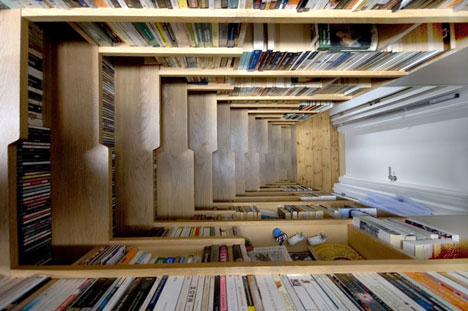
Title: Stairs Bookshelves
Picture Credits: N/A
Link: http://weburbanist.com/2008/04/28/20-brilliant-bookcase-and-bookshelf-designs-creative-modular-and-unique-urban-furniture/
Bookshelves are all functional and rarely seen as aesthetic. They hold a huge amount of books in one place and conserve a lot of space. But a trade-off in being able to place so many books in one place is that the bookshelf builds upward and it can get hard to place or get a book from the top shelf without a ladder. This clever design for a bookshelf is the perfect solution to this problem. The alternating steps that extend out from the bookshelf itself create a stairway to climb upwards enabling the person to reach any area around the shelves. The steps are wide and thick providing a stable space for climbing and the feeling of safety in even sitting on the steps to search for a book. Though this bookshelf was customized for building into the house, it can be easily made for assembling and sold at a store. One can buy it and assemble it inside their closet for their own bookshelf haven.
Weird Architecture


Picture Credits: N/A
Link: http://www.funis2cool.com/unusual/weird-architecture.html
I randomly entered "weird architecture" into Google Images and one of my results was this house. I could not find a name for the house nor who designed it and I could not find anymore pictures of the interior but the house fascinates me nonetheless. With a raised slanted side, it seems as if an old toaster somehow magically assembled itself into the form of a house in the movie "Transformers." It also appears to be in the middle of no where with many dead trees, giving a somewhat frightening atmosphere. The interior of the house, however, is surprisingly very homey. The brightly lit living room with its cream and white clean woodwork and furniture makes it very inviting to be in. The red carpet down the stairs, down the hallway and mahogany-like walls create a very warm environment. There are so many jagged corners that may not be the best idea for a home with children but because of all these edges, it is very eye catching. There are unpredictable corners that the eye is hypnotized in trying to figure out where an edge ends and where another starts. Because of this aspect, I am very attracted to this unique one of a kind building for its endless imaginations and possibilities.
Color Theory: Warm and Cool Colors


Picture Credits: N/A
Link: http://www.porterhousedesigns.com/colorsizzle/
It is embedded into our minds since the beginning of time that blue is associated with cold and red is associated with hot. Perhaps this is simply because blue is the color of the ocean and red is the color of fire and in seeing these colors, we imagine those similar elements. We can physically turn pale when we are cold and pink when we are in anger. We can emotionally feel sad or happy or cold or warm depending on the different colors we see. Therefore, colors are not passive, they can effect how we feel and how we perceive our environment.
The choice of coloring is very important in interior design. The color of the surrounding walls of a room can provide an imaginary temperature to the room as well as the mood of the room. For example, a kitchen with green cabinets, white walls, and blue chairs definitely has a cooling effect on a hot summer day. As opposed to the kitchen with light yellow walls and red cabinets enhancing the heat of cooking on the stove. One can easily imagine drinking a cool glass of water in the green kitchen relieved to get away from the sun or eating a hot chicken potpie in the red kitchen during the winter season. Human beings tend to find emotional and physical comfort in colors and when it is provided, it is easy to sit in the room and just relax.
Sunday, November 1, 2009
3-D Silhouete Chandelier
 Picture Credits: Urban Outfitters
This item can be found here.
Chandeliers are one of the best dining room pieces that provide both form and function; it can light up the entire room and offer a stunning decorative centerpiece at the same time. With the popular concept of minimalism in today's design society, chandeliers are not as significant as they once were. New designs have formed such as this 3-D silhouette chandelier sold at Urban Outfitters.
This DIY modernized design of a chandelier consists of two black cut outs of a silhouette of a chandelier. Placing the two pieces together perpendicularly creates a three dimensional chandelier where a light bulb can be installed in the center. The design is unique and very different giving those rebellious home owners a new taste of contemporary design. As far as functionality goes, the black silhouette might cover some light and/or absorb light. It would probably not lit up an entire room as brightly as a real chandelier would.
The 3-D Chandelier is an easy example of the play between negative and positive spaces. In fact, the entire chandelier is a positive shape leaving everything else as negative space. There is also a slight abstraction in the form of the chandelier. The many chains, gems, jewels, crystals, and complicated structure of a real chandelier is simplified to a few basic curvatures. The few circular modules hanging below represent the decorative jewelry and the candles standing up completes the picture of a chandelier. This all reflects the minimalism that many Americans practice today.
The 3-D Chandelier may not give off the same classy and elegant feature that a real chandelier gives but it fits well into today's contemporary design. Very simple and sleek, the 3-D Chandelier is the new 21st century way of decorating dining rooms for those who want to live in modernity.
Subscribe to:
Posts (Atom)